Ad Breaks Hold Keys to Cash and Product Entry Windows
Taylor Hayes · Aug 20, 2026
Ad Breaks Hold Keys to Cash and Product Entry Windows
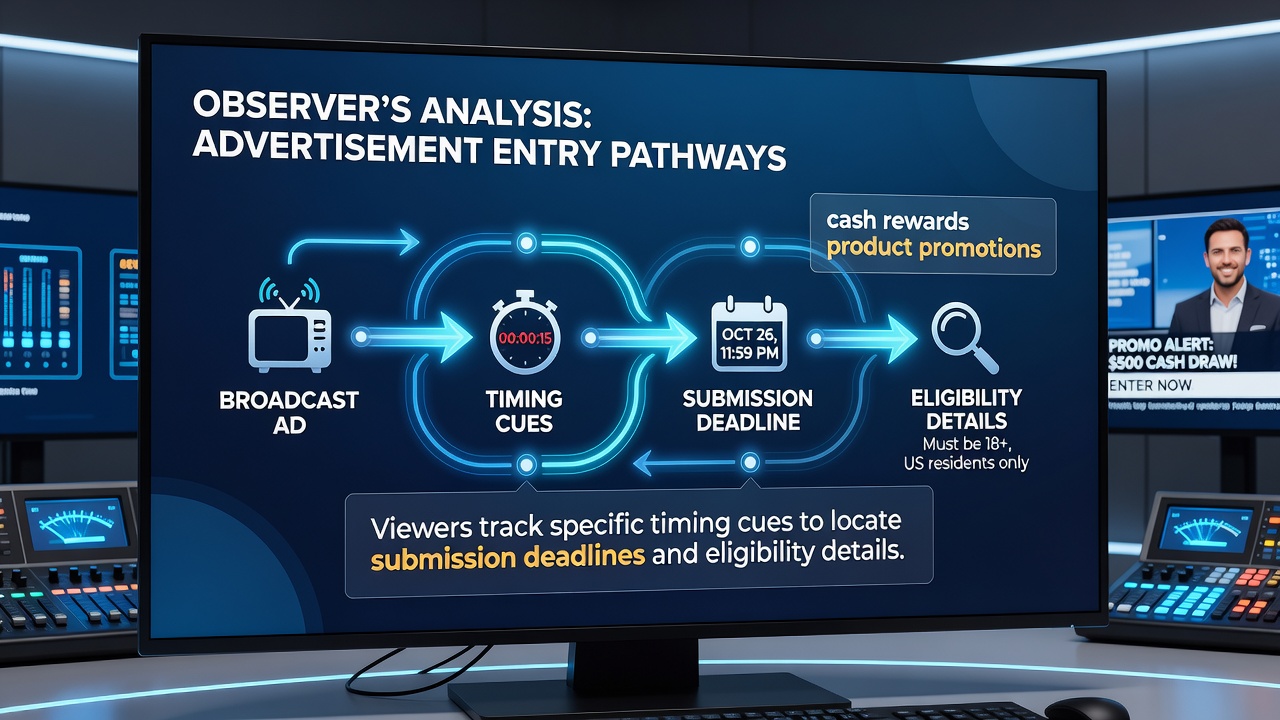
Observers note that broadcast advertisements frequently embed entry mechanisms for cash rewards and product promotions, creating pathways where viewers track specific timing cues to locate submission deadlines and eligibility details. These cues appear in the form of on-screen text, voice-over instructions, and brief mentions of contest periods that run alongside product messaging. Data from advertising monitoring services shows that such integrations occur across multiple channels during peak viewing hours, with patterns repeating in both national and local markets.
Timing Patterns Across Daily Schedules
Research indicates that many commercials place deadline information within the final ten seconds of a thirty-second spot, while longer sixty-second ads often introduce entry steps midway through the sequence. Viewers who record these segments or note the exact broadcast time gain access to precise windows for online or text-based submissions. Figures from media analytics firms reveal that August 2026 saw an uptick in such placements during evening prime-time blocks, particularly in segments promoting household appliances and financial services.
But here's the thing: the placement of these cues follows consistent structures across networks. A voice-over might direct audiences to visit a website before a stated cutoff date, while simultaneous text scrolls list state-specific eligibility rules. Those who study these broadcasts report that cross-referencing the commercial air time with the advertised deadline reduces missed entries.
Eligibility Details and Regional Variations
Eligibility requirements surface through fine-print disclaimers that appear at the bottom of the screen or receive quick verbal mention. According to the Federal Trade Commission, these disclosures must remain legible and audible to comply with advertising standards. In practice, the details include age minimums, residency restrictions, and entry frequency limits that vary by promotion.
Observers have documented differences between U.S. and Canadian broadcasts, where the latter often reference provincial rules alongside federal guidelines. Similar variations appear in Australian programming, with the Australian Competition and Consumer Commission overseeing comparable transparency requirements. Viewers in border markets sometimes encounter dual sets of instructions within the same commercial break.

Tools Viewers Use to Capture Information
People who follow these promotions routinely employ simple recording devices or note-taking applications to preserve the timing cues. Some set reminders based on the exact minute a commercial airs, then cross-check the official entry site once the program resumes. Industry reports confirm that this approach aligns with the short windows many campaigns provide, which can close within forty-eight hours of the initial broadcast.
Turns out the process extends beyond live viewing. Streaming platforms that carry the same advertisements sometimes retain on-screen text longer than traditional linear broadcasts, giving delayed viewers an extended look at deadlines. Those tracking multiple channels note that regional affiliates occasionally adjust the verbal script while keeping the visual deadline unchanged.
Regulatory Context and Compliance Trends
Regulatory bodies require that entry mechanisms remain accessible and non-misleading. Academic studies from communication departments have examined how disclosure placement affects viewer comprehension, with findings indicating that simultaneous visual and auditory cues improve retention rates. In 2026, updated guidance from several oversight agencies emphasized clearer separation between promotional content and entry instructions to prevent confusion.
Yet patterns persist where deadline text appears only briefly. Viewers who pause recordings or use closed-caption archives recover the full set of details more reliably than those relying on memory alone. This practice aligns with observed increases in multi-platform entries that combine television cues with mobile submissions.
Conclusion
Broadcast advertisements continue to integrate entry mechanisms that reward attentive tracking of timing and eligibility information. Data shows these elements appear consistently across schedules and regions, with compliance standards shaping how details reach audiences. Observers document that systematic capture of commercial timing supports participation in cash and product promotions without reliance on repeated viewings.