Deadline Structures in Recurring Draws: Their Role in Shaping Entry Volume Patterns Throughout Promotional Cycles
Gisela Brooks · Aug 20, 2026
Deadline Structures in Recurring Draws: Their Role in Shaping Entry Volume Patterns Throughout Promotional Cycles
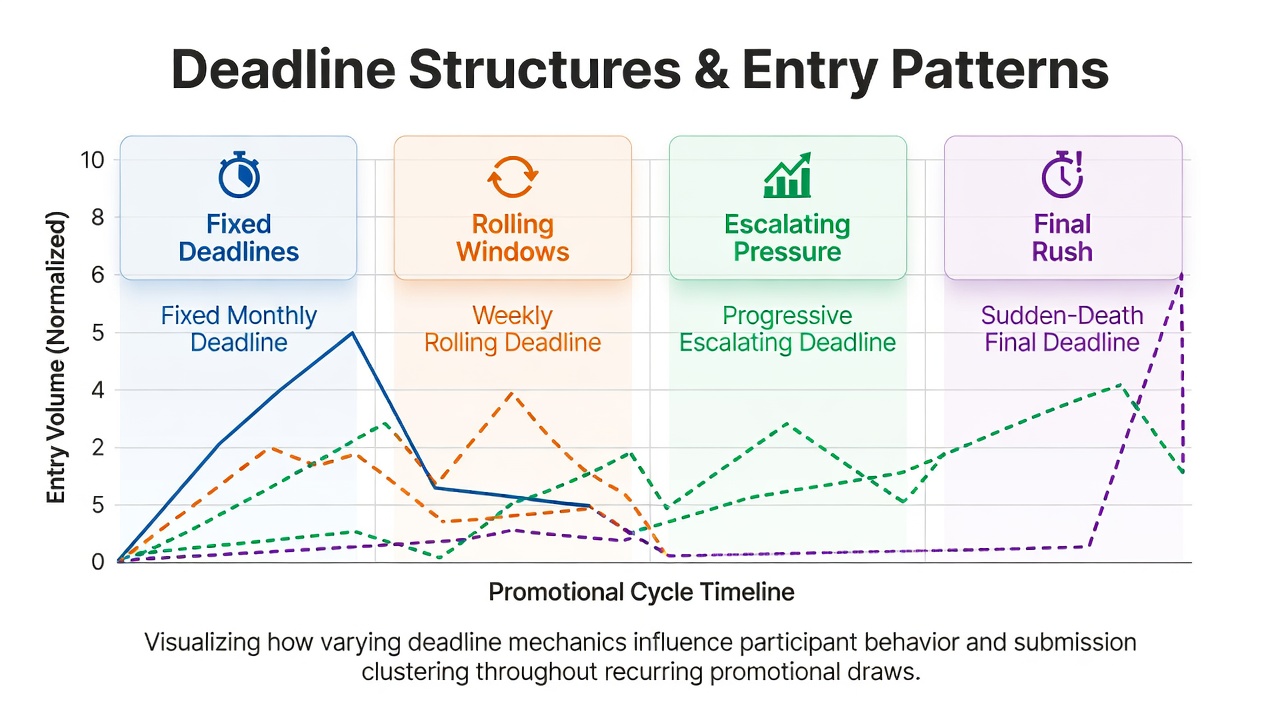
Deadline structures in recurring draws determine when participants submit entries and how volumes rise or fall during each promotional cycle, according to multiple industry analyses. Weekly cutoffs often create steady mid-cycle activity while monthly deadlines concentrate submissions near the end, and data from various platforms shows these patterns repeat across cash, electronics, and apparel contests.
Mechanics of Deadline Timing and Participant Behavior
Recurring draws operate on fixed intervals that reset after each winner selection, and researchers tracking entry logs find that shorter daily deadlines generate consistent daily spikes whereas longer intervals allow entries to accumulate gradually before accelerating. Studies of online sweepstakes platforms indicate that when deadlines fall on weekends or month-ends, total submissions increase by measurable percentages compared with mid-week cutoffs, because participants align their routines with available time.
One examination of several thousand contest records revealed that daily recurring draws maintain flatter volume curves overall, while weekly structures produce pronounced surges in the final 48 hours. Observers note that these surges occur because many entrants treat the approaching deadline as a reminder cue, prompting last-minute activity rather than even distribution throughout the cycle.
Volume Patterns Across Different Cycle Lengths
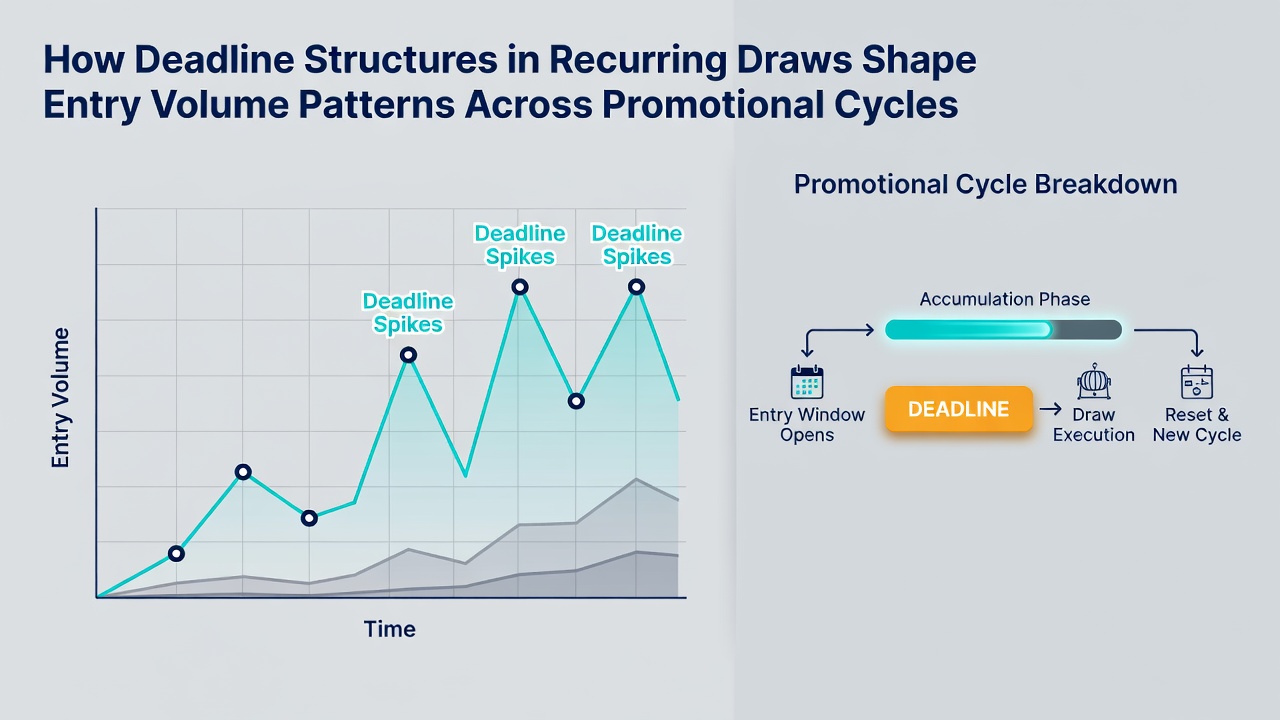
Promotional cycles that repeat draws every seven days typically show entry volumes climbing steadily from day three onward, then peaking sharply on the deadline day itself. In contrast, cycles with 30-day intervals display slower initial growth followed by steeper late-cycle increases, according to aggregated platform metrics collected over multiple years. Figures from marketing research firms demonstrate that monthly deadlines correlate with roughly 40 percent of total entries arriving in the final week, creating a compressed distribution that daily and weekly formats avoid.
During the lead-up to August 2026, several large-scale giveaways illustrated these differences when daily draws maintained even participation while a parallel monthly contest experienced a pronounced rush after the 20th of the prior month. Data indicates that such timing effects persist regardless of prize type, although higher-value items amplify the late-cycle concentration under longer deadlines.
Influence of Reminder Mechanisms and Platform Features
Automated reminders sent 24 to 48 hours before a deadline further intensify volume spikes, and tracking studies confirm that open rates for these notifications rise when deadlines coincide with paydays or holidays. Platforms that display remaining time counters see earlier engagement under weekly structures, whereas monthly formats rely more heavily on the final reminder to drive submissions. Research published by academic institutions in consumer behavior shows that the presence of visible counters reduces the proportion of very late entries, smoothing the curve without eliminating the overall deadline-driven pattern.
Promotional organizers who adjust reminder frequency according to cycle length report more predictable volume forecasts, because shorter cycles benefit from fewer but well-timed alerts while longer cycles require multiple touchpoints to prevent last-minute overload. Those who've examined entry timestamps across campaigns note that the interaction between deadline length and reminder strategy produces repeatable volume signatures that can be modeled in advance.
Regional and Regulatory Factors Affecting Patterns
Regulatory frameworks in different jurisdictions shape how deadlines are communicated and enforced, which in turn influences entry timing. Data compiled by the Australian Competition and Consumer Commission highlights that clear disclosure of recurring draw schedules correlates with steadier entry distribution, whereas ambiguous language increases clustering near cutoffs. In the European Union, consumer protection directives require precise deadline statements that have led some operators to adopt weekly rather than monthly cycles to maintain compliance and manage server loads during peak periods.
Analyses conducted by North American marketing associations similarly reveal that transparent rules reduce participant confusion and moderate extreme late-cycle surges. These regional variations demonstrate that deadline structures do not operate in isolation but interact with legal requirements that affect how and when people submit entries.
Conclusion
Entry volume patterns in recurring draws follow predictable trajectories shaped by the length and placement of deadlines, as documented across numerous platform datasets and regulatory reports. Shorter cycles produce flatter distributions while longer intervals concentrate activity near the end, and reminder systems plus regulatory clarity further modulate these outcomes. Observers tracking promotional performance continue to map these relationships to refine forecasting models for future cycles.